


Nanook Nook
Stories and illustrations by Frank Keim
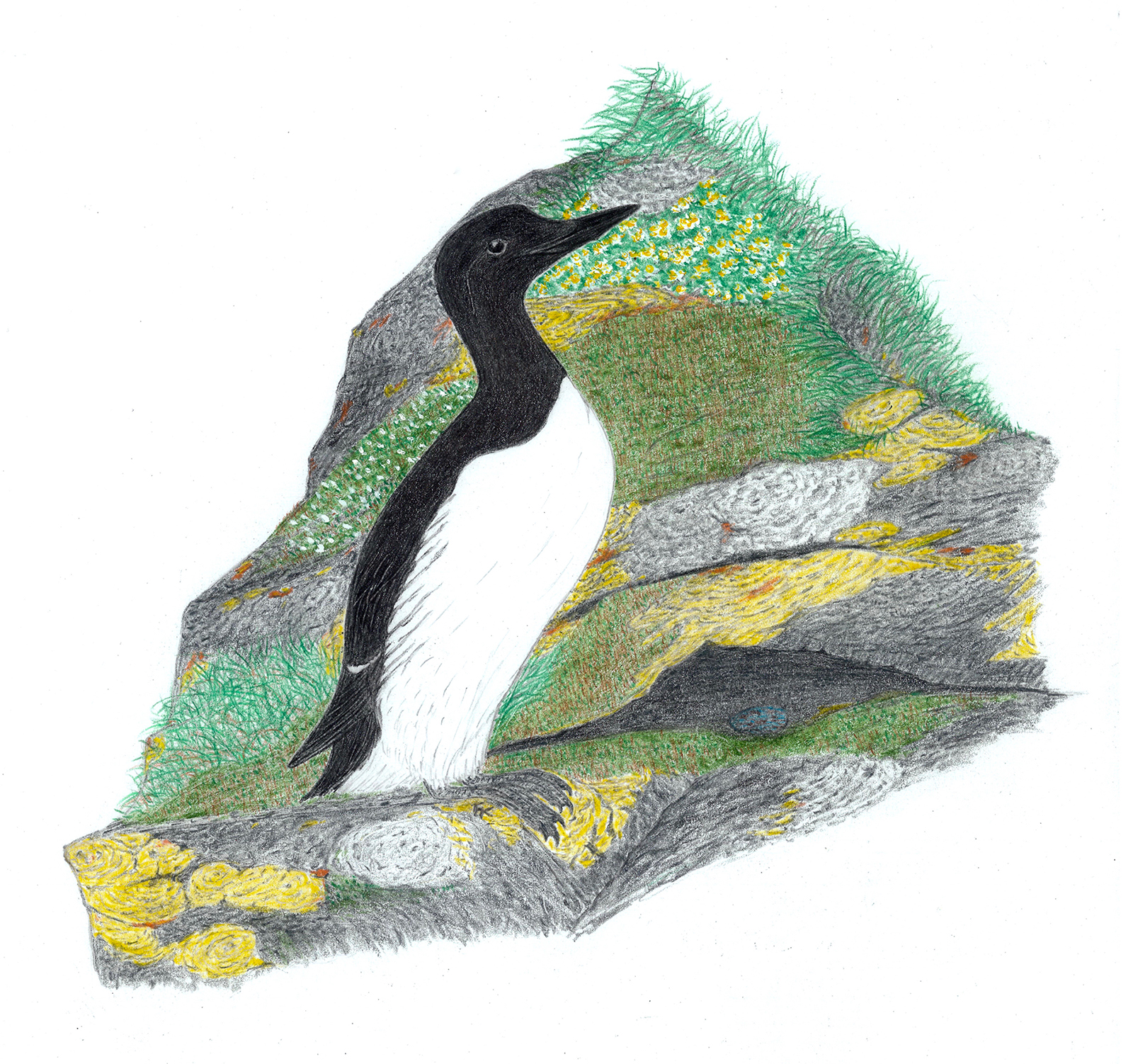
Common Murre
Alpak
I don’t remember ever seeing common murres while living and teaching in the Yukon-Kuskokwim Delta, but I did see plenty of them in both Togiak Bay and Nushagak Bay while helping two friends on different occasions during fishing season. I also remember seeing these seabirds (a species of auk) on the Atlantic coast of Newfoundland while visiting my cousins there in the late 1990s. But they are also found along the Bering Sea coast wherever there are high steep sea cliffs.
If you’re in a boat, you may spot them by the hundreds standing sentinel-like in black and white tuxedos on their rocky nesting cliffs at the edge of the sea. They are in the auk and puffin family, and they have been described as “flying penguins,” although penguins do not live in the north. Their slender wings not only allow them to fly quickly far out on the ocean to search for food but also function as flippers that propel them down under the water to depths of 66-164 feet to forage for small fish, squid, octopus and marine crustaceans such as krill.
In early spring, these sleek seabirds begin migrating north from their winter feeding waters in the North Pacific and head for the cooler, more bountiful feeding and nesting habitat of the Bering Sea. Since common murres don't breed until they are 4-5 years old, younger birds take their time, but older birds are more serious about getting back to their nesting cliffs to claim the same site they use every year. Before nesting, groups of murres often display near the cliffs. They do what is referred to as a water dance, where they patter over the surface of the water, chasing one another. They may also fly in circles, called a joy flight. Pairs both start, and later maintain, their bonds with a greeting, where both birds point their bills skyward, bow deeply, clash open bills together, then preen each other’s feathers, usually while purring or murmuring. One, most often the female, may return to the nest site from the sea with a fish and present it ceremonially to its mate.
Males guard their partners fiercely before egg-laying, chasing off rivals with lunges and jabbing with their sharp bills. They nest in large noisy colonies or rookeries that sound like a madhouse full of deranged raucous laughter, and, although they don’t have nesting territories, they do defend the area on the cliff ledge or near the small cavity in the cliff rock above the sea where the single egg or chick is. They don’t build an actual nest, but sometimes arrange pebbles around their egg on the ledge, then cement them with their guano to prevent the egg from rolling over the cliff. The narrow shape of one end of their egg and broad round shape of the other end also helps to prevent this. If it is accidentally nudged, it simply rolls in a circle around the narrow end. Each single egg has a different color and blotch pattern from all other eggs in the colony, and this amazing variation allows the parents to recognize their own egg when they return to their crowded ledges or cavities. Incubation is by both parents for 28-37 days, and when the chick hatches it is covered in down and able to stand within one day.
The chick is fed by both parents. It leaves the nest at 15-25 days old, even before it is able to fly, awkwardly fluttering down to the water below, where it is fed and cared for by both parents for several more weeks. Its father then teaches it how to hunt and capture its prey, which, in addition to krill, octopus and squid, includes small fish like pollock, various cods, sand lance, sculpin, capelin, herring and smelt. Within 50-70 days the young bird is finally strong enough to lift off the water and fly.
When they forage for food, murres do so alone or in flocks, often with other seabird species. They have been known to dive as deep as 591 feet to hunt and catch their prey, which they hold with their long slender, sharp-edged tongues against sharp nubs (denticles) on the roof of their mouth until they can swallow it. They forage in deep seawater because this is where they find the cold upwelling currents where most of their prey is concentrated. Warm water is not as bountiful as cold water for plankton or other sea animals on up the food chain because it contains less life-giving oxygen to sustain them. Since ocean waters are warming due to climate change, this is cause for concern about the availability of the food supply of these seabirds and others into the future.
With the rate of climate change accelerating over recent decades, Pacific populations of common murres have declined considerably. As ocean waters continue to warm, this change will have significant and possibly catastrophic effects on murres and other seabirds. Much of their feeding and nesting range will be forced to shift farther north into the high Arctic and, with pollution from oil spills, drowning in gill-netting operations, overfishing of prey species and hunting of murres in the Arctic, the future doesn’t look good for them.
The English name “murre” is imitative of the purring or murmuring sound they make at their rookeries. Other common names of the seabird are thin-billed murre and common guillemot. Their scientific name, Uria aalge, is Latin-Danish for auk (Danish: aalge) and guillemot (Latin: uria). The Yup’ik name I found in the Y-K Delta for common murres is alpak, possibly having something to do with the way they eat their prey.
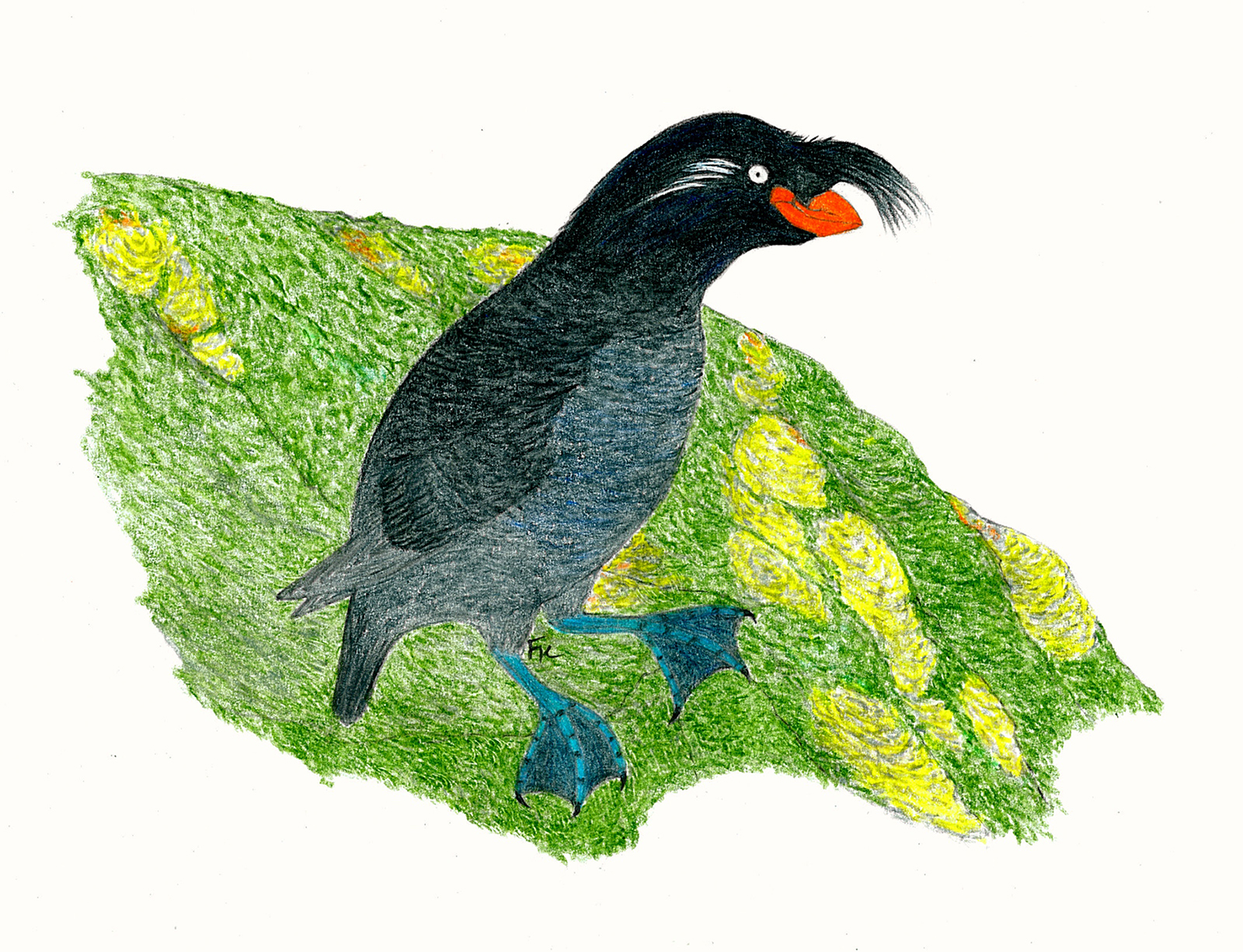
Crested Auklet
Culuksuksaar(aq)
The Yup’ik name, culuksuksaar(aq), that people in Hooper Bay and Scammon Bay gave me for this handsome parrot-beaked seabird is one of the most descriptive that I’ve run across yet. It loosely means having a feather or fin decoration on its body (on its head, in this case). It derives from culuk and culugaq, meaning quill of a feather or fish’s dorsal fin, and culuksuk or culuksugun, meaning a decoration hanging from a parka that looks like a feather quill or fish fin. On Nunivak Island, they call the bird cip’lagaq, probably having something to do with their courting ritual.
Similar to its cousin the parakeet auklet, the crested auklet is a small chunky seabird with an ornamental tuft of black feathers hanging down from its forehead. It is seen only on and around Bering Sea offshore islands and coasts with high craggy cliffs. Seal hunters may see them if they happen to be hunting in the coastal waters of Nunivak Island or in deeper waters on the open sea. If you’re lucky, you may also see them foraging near the Hooper Bay-Scammon Bay coast.
You can’t mistake them because they feed in huge flocks while swimming and diving together in deep water, sometimes as much as 100 feet below the surface. They especially like to feed in areas where there is turbulence caused by upwellings or strong tidal flows in passes between islands. Their diet is mostly tiny zooplankton, including euphausiid shrimp and copepods that occur in enormous swarms, although small fish and squid are also a part of their menu. According to Hector Douglas, a bird scientist, it’s probable those same shrimp are responsible for the bird’s bright tangerine-colored beak. Further, he says this auklet is the only seabird that smells like a tangerine. When he isolated the chemicals responsible for the scent, he found them to be the same as those in citrus fruits and stink bugs. He thinks they may help attract a mate, as well as repel ticks, lice and mosquitoes.
Crested auklets nest in colonies on steep rocky islands among the boulders of talus slopes and broken lava flows, as well as on cliffs with many cracks and crevices. Their colonies are extremely noisy places, with birds whistling, barking and honking from their crevices among the rocks. They usually fly in tightly packed flocks and, especially during the mating season, perform mass circling maneuvers, soaring, swooping and diving near their colonies.
Culuksuksaarat first breed when they are 3 or 4 years old. After the male finds a deep crack or crevice in the cliff rocks for a nest site, he goes a-courting. If there are eligible females in the vicinity, he puffs out his chest, then points his bill at the sky and makes honking sounds. If a female approaches him, the pair touch bills and preen each other’s neck feathers. Like their other small auk cousins, they also intertwine their necks. When things get serious, the female scrapes a shallow depression in soil or pebbles at the bottom of the cavity. Sometimes this may be several feet below the surface of the rock pile.
Egg-laying is next, but only one, and, since it is laid in a dark cavity, it is predictably white so the parents can readily see it. Incubation is by both sexes for about 34 days. After the egg hatches, both parents feed the one young bird, carrying back high-energy seafood in their throat pouches. The young are reported to be noisy, making peeping sounds when the parents are present, and whistling when they are absent. After a month of being fed, the young bird ventures out from the safety of its little cave, exercises its wings for a few days, then takes an awkward leap of faith into the moist sea air above the Bering Sea. If it successfully manages to escape the deadly rocks and breakers below, it joins its parents in foraging for the same zooplankton and small fish and squid as they and the rest of the colony do.
During the onset of winter and the formation of ice over the Bering Sea, the colonies of crested auklets migrate south to winter in protected marine waters around Kodiak Island. Siberian birds winter south to northern Japan and the Kuril Islands.
Back to names again, the English common name is self-evident, and the scientific name, Aethia cristatella, is a direct translation from the English. In the Yup’ik dialect, Koniag Alutiiq (Sugpiaq), once spoken in Kodiak and the upper Alaska Peninsula, the crested auklet’s name is reported to be kungyuk, which relates to its Koniaq origin.
Kodiak elders recalled taking these birds in the winter. They hunted them on the water, often with the help of moonlight or by the light of the rising sun. Since they were small birds, hunters took many of them at a time, which they roasted or included in their soups. These elders also said that the auklets were more numerous in the past, as they now seldom occurred in large flocks and are no longer hunted.
Although the birds are presently not considered endangered, the observations of Native people who hunted them over many years can teach us about important changes in their seasonal cycle that Western scientists still know little about. Their knowledge can also provide us with valuable information on the harmful impacts of humans on the environment, including the consequences of climate change.
Since the preferred food species of crested auklets and other seabirds in the Bering Sea region and northern Pacific Ocean reproduce more robustly in cooler waters, climate change and warmer waters will undoubtedly result in the reduction of their populations.

Parakeet Auklet
Taituiq
As its English name “parakeet” suggests, this auklet looks a little like a small parrot. But don’t be fooled, it is far from a parrot. Watch the way it stands, walks, flies, hunts and calls — totally different. It stands and walks on its legs, not its toes; it flies in fits and bursts over seawater, and it chitter-calls more like a cicada, a noisy insect found in the Lower 48. It also hunts on and under the surface of the sea, using its red conical bill to catch and handle slimy gelatinous prey like jellyfish.
In late winter, adult birds migrate northward into the Bering Sea from their wintering habitat in the northern Pacific Ocean. This is usually four to six weeks before nesting begins in the vicinity of their loose colonies on the ridges, rocky outcrops, pinnacles or talus slopes of steep maritime cliffs, many of these on isolated islands such as Nunivak, St. Matthew, and the Pribilofs. The courtship rituals are not as well known as those of the crested auklet, but, since the two species are so closely related, they are probably similar.
After the auklets’ hormones kick in at about 3 years of age and they are well fortified from the good hunting in the Bering Sea, they return to the isolated rocky island cliffs where they were born and begin their courtship ritual. This may include chest-puffing by the male while perched on a rock outcropping as the female watches nearby, plus high-pitched chittering whistles and sky-gazing with his conical red bill, followed by bill-touching, mutual preening and neck-entwining by both male and female.
Parakeet auklets only nest as isolated pairs or in loose colonies with crested auklets. Their nest site is in a deep crevice on a craggy cliff, ridge or rocky slope partially covered with vegetation. The pair adds no nest material, and their single egg is laid on bare soil or rock. Both parents take turns incubating the whitish or pale blue egg for about five weeks, and, after taking a break to eat, the free bird will sit on the cliff ledge near its nest and watch for danger while its mate incubates the egg or tends to the chick. After the egg hatches, both parents help feed the young by bringing food (small fish or soft foods like jellyfish) to the nest in their throat pouch and regurgitating it into the throat of the young. About five weeks after hatching, the young bird flutters down to the water and begins to follow the example of its parents and forage from the surface or under the water for jellyfish, small fishes and small crustaceans like euphausiid shrimp and amphipods.
As with other bird species that nest in the Bering Sea, parakeet auklets are being affected by the warmer temperature of the seawater caused by climate change. Warmer water temperatures reduce the fertility of the ecosystem, meaning less food for these seabirds. The introduction of rats and Arctic foxes to some islands have also reduced their population there.
The Yup’ik name for parakeet auklet I was given in Hooper Bay and Scammon Bay is taituiq, in reference to its foggy or misty nesting habitat. Taituk means fog or mist; hence “bird of the fog or mist.” The Nunivak Island Yup’ik name for this auklet is ciruraq, probably having something to do with their funny parrot-like face. The common English name, parakeet auklet, refers to the bird’s resemblance to a small parakeet-like parrot. The name parakeet itself comes from the French word perroquet, which in turn means parrot. Finally, the bird’s scientific name, Aethia psitticula, means “diving parakeet.”
Something fascinating I learned about the bird’s ancient history is that the first generic auk fossils are from the middle Miocene epoch (15 million years ago). The first Aethia auk fossils date from the late Miocene (8 million-13 million years ago), and the four Aethia auk species living today probably diverged from the former about 5 million years ago. So, they’ve been around in their present form for a long time — much longer than we have.
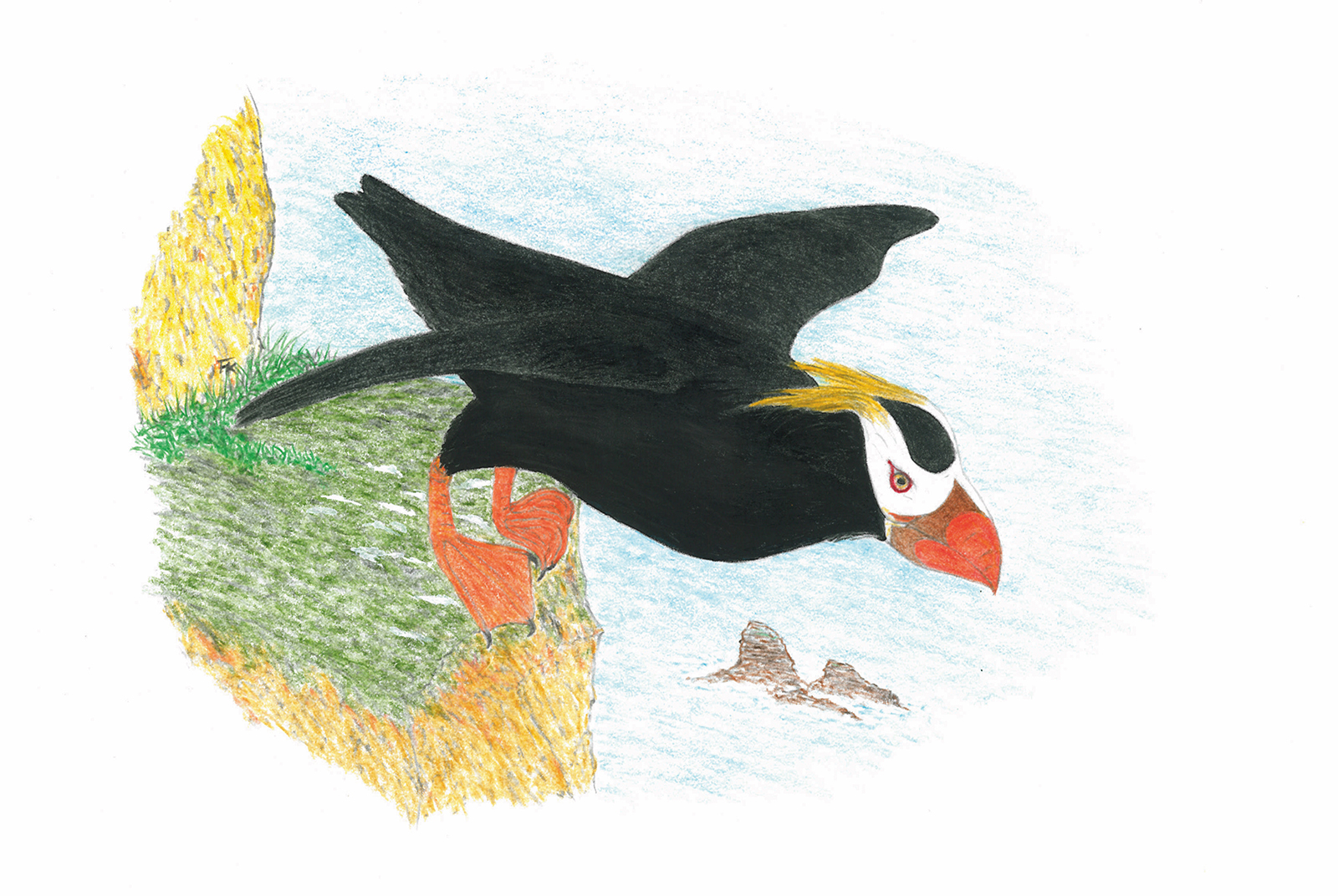
Tufted Puffin
Qilangaq/Tunngaq
This is another of those auks (alcids) I never saw while living in the Yukon-Kuskokwim Delta because its nesting areas in the Bering Sea were just too difficult for me to get to. They nest colonially in burrows mostly on treeless islands with grassy steep slopes or cliff tops with sheer drop-offs. Along with other auk and gull species that nest nearby, their colonies become very busy in spring and summer, with flying and diving birds everywhere. I’ve only witnessed this activity, however, in Prince William Sound while kayaking in the area many years ago.
I’ve also watched them at the Seward Sea Life Center as they swam and dived in the enormous glass aquarium there. And do they put on a show! Along with their first cousins, horned puffins, they literally fly underwater while foraging for small fish, pushing themselves mostly with their stubby wide wings, and turning and twisting on a dime with the help of their orange webbed feet and tail. And, although they are also adept at flying in the air, they have to work hard to take off, running along the surface of the water for all they’re worth and using the thermals generated by waves to become airborne. This is why they dig their burrows into steep hillsides or on craggy slopes or cliff faces, so they can use gravity as an assist to propel them aloft. As they do underwater, they use their feet and tail to help them steer while flying.
Since tufted puffins migrate far out on the open Pacific Ocean outside of the nesting season, not much is known about their courting rituals. By the time they return to an ice-free Bering Sea in March or April to begin nesting, they have already formed their pair bond and are ready to get to the serious task of finding a place to call home for a few months. Both sexes help excavate their nest in a long (2- to 7-foot) burrow on a steep grassy slope in a deep natural crevice among the rocks, or less seldom, on the ground under a shrub on a steep incline. At the end of their burrow, the pair lines the nest chamber with grass, feathers or other soft materials.
The female lays one lavender-brown spotted bluish white egg, which is incubated by both parents for 40-42 days. Both parents also help feed the nestling, carrying four to five fish in their bills and dropping them inside the burrow by the nest or near the entrance. Since they hunt for their quarry farther from the colony than horned puffins, it may take up to two days for an adult to return to the nest with its quarry hanging in its bill to feed the chick. The young bird leaves the nest six to seven weeks after hatching. Tufted puffins only have one brood per year.
After taking its first daunting leap off its nest perch into the sea, the young puffin quickly gets down to business and fattens up with a diet rich in oily fish, such as sand lance and capelin, although it may also feed on small squid, crustaceans, mollusks, sea urchins and algae. Its parents do not feed it but model the foraging behavior necessary for its survival.
Tufted puffin young usually stay in the vicinity of their noisy nesting colonies in the Bering Sea until the water freezes, although with climate change and open water lasting longer, they are able to take advantage of the bounty found there till much later in the year. But finally the time comes when they must disperse farther south into the southern Bering Sea and the open reaches of the Pacific Ocean to hunt for their favorite foods.
This puffin has two Yup’ik names that I’ve run across: In Hooper Bay, I found qilangaq, the meaning of which is unknown; in Scammon Bay and the Yukon, they’re tuungaq, which probably refers to the saucepan, or bowl shape of their wide colorful bills. Their Aleut name is toporkie, which has a Russian origin. They have a number of other common English names including, old man of the sea, sea clown and sea parrot. Their scientific name, Fratercula cirrhata, means, “little friar (brother) with curled locks or ringlets.”
Something fascinating about tuungaq is that, although both males and females have the same garish plumage and golden tufts and gaudy parrot-like bills during the late spring and summer months, these traits change dramatically in the fall. Then their plumage fades to brownish-black, and they shed their colorful yellow bill plates, rosettes and blonde ornamental eye tufts, leaving their appearance much plainer and less imposing for human eyes to ogle with binoculars.