


Drumbeats Alaska Consortium is dedicated to advancing food and energy sovereignty across Alaska Native lands. Through pioneering research and community-driven outreach, we provide the hands-on instruction necessary to build a sustainable future. Our clear mission is to cultivate knowledge and foster a new generations of local leadership.
This program is supported by the USDA National Institute of Food and Agriculture, Alaska Native-Serving and Native Hawaiian-Serving Institutions Education Competitive Grants Program.
The Drumbeats Alaska Consortium unites academic and community outreach programs from five Alaska Native-Serving Institution campuses within the UAF College of Indigenous Studies. Each participating campus drives a critical component of our focus:
- Ethnobotany (EBOT) | Kuskokwim Campus - Bethel
- High Latitude Range Management (HLRM) | Northwest Campus - Nome
- Sustainable Energy (SE) | Bristol Bay Campus - Dillingham
- Tribal Governance & Stewardship (TGS) | College of Indigenous Studies - Fairbanks
- Traditional Crafts and Native Language (TCNL) | Interior Alaska Campus - Fairbanks
Our programs offer diverse learning experiences, from distance learning to immersive, place-based instruction. We proudly support community efforts to sustain traditional ways of life.
Drumbeats supports faculty in delivering exceptional curricula in food, agricultural, and natural resource systems, traditional crafts, tribal governance, and science. By integrating place-based Indigenous and Western knowledge, we create relevant learning experiences that boost student recruitment and retention.
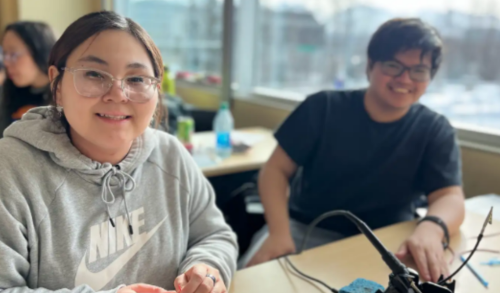
 Photo: A 2025 Alaska Ethnobotany class on Kuskokwim Campus
Our Story
A Legacy of Growth and Partnership
Since our founding in 2005, Drumbeats has evolved from an ambitious idea into a dynamic force for Indigenous-led education. Launching our first academic programs in 2007, we expanded our focus by 2009 to include vital agricultural and subsistence sciences. A landmark moment came in 2013 with the creation of our Tribal Stewardship courses, cementing our commitment to centering Indigenous knowledge and leadership.
For the past six years, our work has been expertly guided by Principal Investigator Carrie Stevens, a Professor in the Department of Tribal Governance, in collaboration with co-program directors from the Kuskokwim, Northwest, and Bristol Bay Campuses.
Our success is a testament to our strong university and community partners and the dedicated students who champion self-determination. We are deeply grateful for their collaboration, which uplifts time-honored Indigenous knowledge and ways of being across Alaska.
Explore our programs and partnerships to see how we are building a sovereign future together.

This work is supported by the Alaska Native-Serving and Native Hawaiian-Serving Institutions Education Competitive Grants Program, [project award no. 2024-38470-43416], from the U.S. Department of Agriculture’s National Institute of Food and Agriculture. Any opinions, findings, conclusions, or recommendations expressed in this publication are those of the author(s) and should not be construed to represent any official USDA or U.S. Government determination or policy.