


Field Policies
Toolik Field Station has a variety of policies and requirements to review before coming to the station.
Responsible and respectful conduct is expected at Toolik Field Station. The camp management team has the ability to remove any staff member, contractor, or member of the scientific community from camp if that person’s behavior raises concern for the community.
Responsible and respectful conduct is expected at Toolik Field Station. The camp management team has the ability to remove any staff member, contractor, or member of the scientific community from camp if that person’s behavior raises concern for the community.
All staff, contractors, researchers, and visitors are required to take a code of conduct training yearly and adhere to Toolik Field Station's Code of Conduct while at the station or station-sponsored events.
Alcohol and Drug Policies (Strictly Enforced)
Toolik Field Station is an alcohol-free workplace. Toolik residents may bring alcohol to the Station for personal consumption outside of work hours. We expect moderate and responsible behavior and consumption. Residents and staff who create problems while under the influence of alcohol may be dismissed from the station. Furnishing alcoholic beverages to any person under the age of 21 will be grounds for immediate expulsion from Toolik.
Toolik residents shall not purchase, arrange for transport, or transport alcoholic beverages or illegal drugs to the Toolik Field Station for other residents or Toolik staff. Sanctions include dismissal from camp and notification to the Alaska State Troopers.
Alcoholic beverages may not be stored or consumed in work areas. Work areas are defined as shops, labs, aircraft, or motor vehicles of any type. Alcoholic beverages discovered in work areas will be immediately removed and disposed of.
If you wish to bring alcohol, please only bring aluminum cans; there is no glass recycling in Alaska, so it’s important to keep glass usage at a minimum.
Toolik Field Station is a drug-free workplace. The station is located on land leased from the Bureau of Land Management (BLM), a federal agency and TFS/UAF is federally funded (NSF), requiring compliance with federal law. So please note that even if marijuana was legalized in Alaska, it is not legal to possess or use it on federal land. Use and distribution of illegal drugs at Toolik will not be tolerated. Anyone suspected of illegal drug use will be asked to leave the premises. Any illegal drugs discovered will be turned over to the Alaska State Troopers.
Toolik is a tobacco-free location. For more information about the UAF Tobacco policy:
https://www.uaf.edu/tobaccofreecampus/
The Scientific Liaisons ("Senior Scientists") act as consultants to the camp management
team on issues that affect scientists working at TFS. The Scientific Liaisons facilitate
communication between members of the scientific community and camp staff to assist
in the resolution of disagreements among members of the scientific community, or between
scientists and other inhabitants of Toolik. The Scientific Liaisons are available
to help members of the scientific community if they don't feel comfortable discussing
issues directly with the camp management team. The Scientific Liaisons and camp management
team maintain open communication to coordinate responses to issues of concern, resolve
conflicts before they escalate, and before making decisions that affect the scientific
community.
Starting 2021, there will be 2 Scientific Liaisons to represent more genders.
Protocols for the Scientific Liaisons
The camp management team and the Scientific Liaisons work closely on all matters concerning camp operation. We hope that most issues can be resolved through communication with the interested parties, the Scientific Liaisons, and the Facility Supervisor.
If a member of the scientific community is behaving in an inappropriate way or causing problems for the camp, the Scientific Liaisons should first inform that person’s PI/project leader, who has responsibility for the actions of project members. If the PI/project leader is unavailable or unable to correct the problem, the Scientific Liaisons are authorized to take additional steps. Both the camp manager and the Scientific Liaisons have the authority to issue formal warnings to any member of camp whose behavior is causing problems for the community, at any time.
The purpose of this Code of Conduct is to restate important principles and expectations for professional conduct and acceptable behavior by all personnel. While non-exhaustive, this Code is a shared statement of commitment to uphold the ethical, professional, and legal standards required to fulfill these principles and objectives
The new (2018) Principles can be downloaded from this URL:
https://www.nsf.gov/geo/opp/documents/policy/polar_coc.pdf
The 2018 revised core Principles for the Conduct of Research in the Arctic are:
- Be Accountable
- Establish Effective Two-way Communication
- Respect Local Culture and Knowledge
- Build and Sustain Relationships
- Pursue Responsible Environmental Stewardship
Comments may be submitted to: iarpcprinciples@nsf.gov
Letter of Support - Meeting with Donie/Faustine/Amanda to discuss
*How/what do I need to do to work at Toolik?
Permit Contacts & Information
- Check with the land owner to see if your proposed activities are allowed
BLM Requested Information:
Activities fall under two categories:
- Casual Use: Depending on your proposed sampling plan, your activities might be considered “Casual Use”. Casual use activities could be….. BLM ultimately makes the final decision on whether your activities would be considered casual use, and if so, they will provide you with a letter stating so.
- Authorization Permit: Permits charge by site, and how long you plan on leaving equipment and infrastructure on the landscape. INTERACT and other international researchers please contact Toolik GIS (hotlink) for specific information.
Note: Boardwalks are required by the BLM in some situations, depending on how often you will be accessing your site, the type of landscape your site is located on, and how many people will be accessing the site. There will be additional costs involved if boardwalks are deemed necessary, in addition to the cost of installing the boardwalks.
Toolik researcher questions for authorization application/casual use determination.
- Who would authorization be to?
- Name of institution, contact name, address, cc address, the name on the authorization should be the party responsible for the rent and processing payment.
Where will the activity occur?
- Meridian, Township, Range, and Section ideally, and lat and long in Excel CVS spreadsheet if possible.
- Map of locations in consultation with Toolik Field Station.
Ground disturbance:
- How will the ground be disturbed?
- What size area to what depth?
- Will there be measurements or samples be taken?
- What quantity of samples will be taken over how large of an area?
- If samples are taken will there be removal and replacement or will samples be removed permanently?
- Will equipment be left on the land? Seasonally or long term?
- Does the equipment require power? What is the source? Battery, Solar, Fuel?
- What is the plan for fuel handling and spill prevention or clean up? (State's spill info here: https://dec.alaska.gov/spar/ppr/spill-information/reporting)
- Is there a plan for removal of equipment if the activity is abandoned?
- Is the activity short (3 years or less) term? or long term?
Site Access:
- How will sites be accessed?
- By vehicle on existing roads, pullouts?
- By foot on existing trails and boardwalks?
- If crossing tundra what is your method of access in what months?
- Will additional boardwalk be necessary?
The more complete the information is in the original proposal the faster we can move forward.
Additional Considerations:
Include info here from FAQ listed on existing website page.
Combine: Fish/Wildlife/Invertebrate
Current link to website works for IACUC
Bridget Watson (Sr. Research Compliance Officer)
UAF, Office of Research Integrity
TEL (907) 474-7832
bjwatson@alaska.edu
*Need to check North Slope Borough Permit Application info cautiously
Radioactive Material? - Contact Scott Fillipinoe, TFS Safety Manager
Does your project plan to use a UAS?
DNR UAS Policy
Drones for International Researchers wanting to fly UAS in the USA
Project Registration
All research projects need to register their project in the myToolik System
Site Selection
Use existing info on website
Apply for Permit
See above in Step 2 for….
Same info as on current website
Upload permit to your myToolik Account
BLM -
Sheri Wilson
Realty Specialist
Central Yukon Field Office
Bureau of Land Management
222 University Avenue
Fairbanks AK 99709-3844
(907) 474-2246
Alaska Department of Natural Resources, Division of Mining, Land and Water -
Melissa Head
Natural Resource Specialist
North Slope Permitting
Northern Regional Office
3700 Airport Way
Fairbanks, AK 99709
TEL (907) 451-2719
FAX (907) 451-2751
melissa.head@alaska.edu
Gates of the Arctic National Park -
Permit Coordinator
National Park Service
Fairbanks Administrative Center
4175 Geist Road
Fairbanks, Alaska 99709-3420
TEL (907)-457-5752
Permit application deadline is March 31st for projects starting between May 1 - August 31. If applying for a permit outside this time frame apply at least 60 days in advance.
Arctic National Wildlife Refuge - Contact Info
101 12th Ave., Room 236
Fairbanks, AK 99701
TEL (907) 456-0250 (general refuge number)
FAX (907) 456-0428
arctic_refuge@fws.gov
Accept permit applications from January 1 - April 15th and October 1 - November 30th
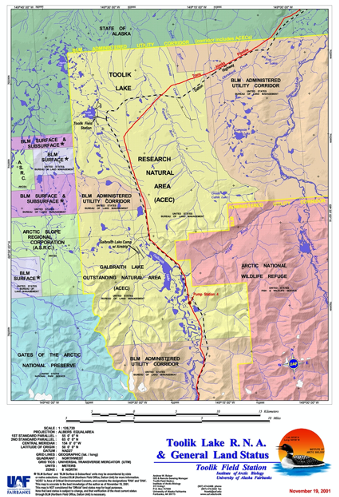
Contact Toolik GIS for help identifying research locations suitable for your project. BLM requires a map created by Toolik GIS to be included in your permit application.
When: 6 months lead time is required for permitting.
For an overview of all University of Alaska IT Policies, Procedures & Computing Standards, Best practices and BOR Policy & Regs visit:
IT Policies & Security Standards
Or contact
907-450-8300
1-800-478-8226
Policy for Unmanned Aerial System Operations (UAS) at Toolik Field Station UPDATE 5/23/2017
Objectives:
To provide a safe operating environment for all researchers, aviators, and other people and property in the area of Toolik Field Station (TFS),
To comply with all Federal Aviation Administration, University of Alaska, and other applicable Rules and Regulations,
To enable research development in the field of UAS (including winged and rotary-wing aircraft, balloons, and kites), as possible, once safety and regulatory requirements are fulfilled
Requirements for UAS Operations at Toolik
- All TFS researchers using a UAS for research, educational or academic operations must follow the rules stipulated in 14 CFR 107 and 14 CFR 48 .
- All TFS researchers using a UAS should review Advisory Circular 107-2 .
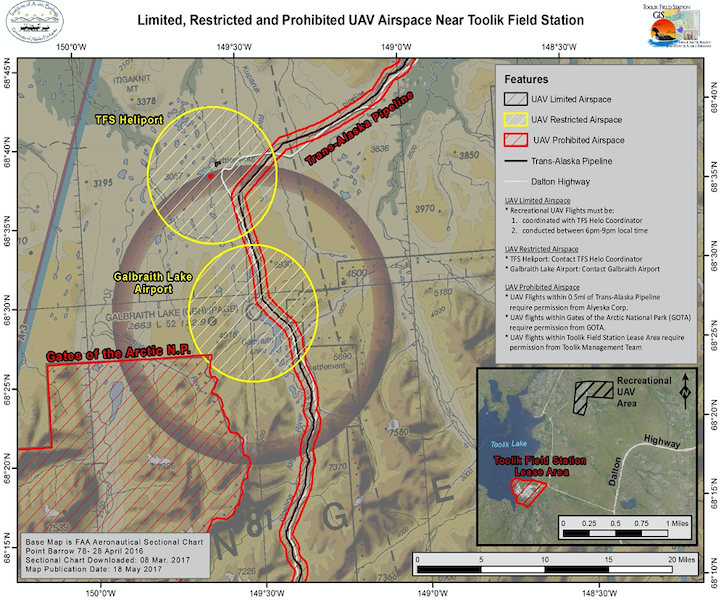
- All researchers who reside at TFS and plan to use a UAS for recreation or research must be aware of special airspace restrictions as presented in the “Limited, Restricted and Prohibited UAS Airspace near Toolik Field Station" map attached to this policy document."
- All TFS-based UAS use must be described in the project’s BLM permit. All BLM UAS stipulations must be followed. A copy of the project’s BLM permit must be on file with the TFS station manager.
- All research projects must contact the TFS UAS coordinator prior to arriving at the station to review proposed UAS areas, UAS operational plans, and safety plans.
- Research project pilots must hold a current FAA remote pilot airman certificate with UAS rating or hold a current Part 61 pilot certificate and complete a FAA UAS on-line course.
- Research project pilots must provide a copy of their FAA remote pilot airman certificate with UAS rating or Part 61 pilot certificate with UAS course completion to the TFS UAS Coordinator prior to arriving at the Station (contact information below).
- All UAS must be registered and marked as per 14 CFR 48. Research projects must provide a FAA registration number for each UAS to the TFS UAV Coordinator (contact information below).
- Upon arrival at the station contact the TFS UAS coordinator and CPS helicopter coordinator to update them on your project’s UAS areas, operational plans, and safety plans.
- Project UAS pilot must contact the CPS Helicopter Coordinator 24hrs in advance of each flight.
- Project UAS pilot must meet with CPS Helicopter Coordinator for a mandatory briefing on day of planned flight. Daily briefings are held between 8:00 am – 8:30 am in the helo coordinator’s tent.
- 6. Project UAS operations plan must designate a knowledgeable and experienced radio operator to be in constant contact with the CPS helicopter coordinator, and monitor local traffic frequencies. Projects are responsible for providing their own Aircraft band radio. NOTE: TFS VHF helo coordinator radios operate on different public service frequencies and cannot communicate with civilian aviation aircraft.
- Any UAS pilot must be familiar with local ATC towers, special airspace restrictions and equipment in the Toolik Lake Research Natural Area and mitigate risk of damage to property by avoiding these areas. (See attached map, “Limited, Restricted and Prohibited UAS Airspace near Toolik Field Station" attached to this policy document.
- UAS flights within 0.5 miles of Trans-Alaska Pipeline require permission from Alyeska Pipeline Service Company (see attached map).
- No UAS flights are permitted within or over the Toolik Field Station BLM Lease Area. (See attached map).
- Recreational flights must follow FAA Part 101 and are only permitted at designated areas between the hours of 6pm-9pm. Data gathered while operating as hobbyist (under 14 CFR 101) cannot be used for monetary gain, including in publications that were funded through grants. If you want to fly UAS and use the data in a publication, you must fly under 14 CFR 107. (See attached map).
Support and Points of Contact:
Jason Stuckey, UAS Coordinator: jjstuckey@alaska.edu
CPS Helicopter Coordinator: toolikhelo@Polarfield.com
Mike Abels, Toolik Compliance Officer: maabels@alaska.edu
Dependent Children at TFS
Policies for parents with dependent children at TFS (0 to 5 years old)
- Parents must provide for the transportation of their child to and from TFS.
- Parents must provide a plan for 24-hour supervision of their child while at TFS, to be provided by the parent, or by a daycare provider furnished by the parent. Supervision includes plans for feeding, recreation, naps, and sleeping.
- Day care providers furnished by parents are required to be certified in first aid and infant CPR. Parents must submit copies of this certification to the station management prior to arrival.
- Parents shall ensure that their children have had all appropriate vaccinations before bringing them to TFS.
- Dependent children are not allowed in the workplace, as per UAF policy (see Chancellor's web page). Laboratories, kitchen, the generator modules, and shop facilities are considered to constitute the workplace at TFS. Children may not ride in university boats or any other mode of transportation, other than the vehicle used to get to and from the station.
- Dependent children are permitted in the housing facilities, the dining hall, the outhouses, and the community center/daycare facility. Dependent children may play in the tundra so long as they are not in experimental plots or sensitive areas, and are under supervision. A site map outlining approved areas will be made available.
- Dependent children will be housed with their parents in the regular TFS housing facilities. TFS provides mattresses but not bedding. Parents must supply their own bedding and cribs, if needed, for their children.
- Parents using the community center/daycare facility must provide their own bedding and crib or nap mat, all toys, disposable diapers (if needed), and any required food beyond what is provided by the regular TFS meal service.
- Parents or caregivers are responsible for clean-up of the center, beyond routine sweeping and removal of trash.
- TFS will not charge dependent children any fee for the use of TFS. The fee for their caregivers to stay at TFS shall be the same as other science users covered by the co-operative agreement.
- Parents who want to bring their dependent children to TFS must submit a request to the TFS Science Director at the same time as they make reservations for themselves, according to the published deadlines for reservations at TFS, and explain their reasons for wishing to bring their children. Requests will be evaluated on a case-by-case basis and acceptance or denial of each request will be dependent on space availability and the plan for adherence to points #1-9.