


Check out the following videos to learn about ACEP projects.
Solar Economics and Information for Anchorage
This video provides answers to the most common questions about and an in-depth look at the current economics of solar panel installations. It focuses on installations in the Anchorage area, where the Solarize model started in Alaska, but much of the material is applicable in other parts of Alaska.
A Solar Design Manual for Alaska
Solar electricity: Solar energy can be directly converted to electricity, using photovoltaic (PV) cells. This manual includes a detailed discussion of PV applications.
Solar heating: Solar technologies use the sun’s energy to heat a fluid. They are practical for providing domestic hot water in Alaska. There is also a growing interest in greenhouse and agricultural use of solar energy to produce food locally.

ACEP: Research Partnerships
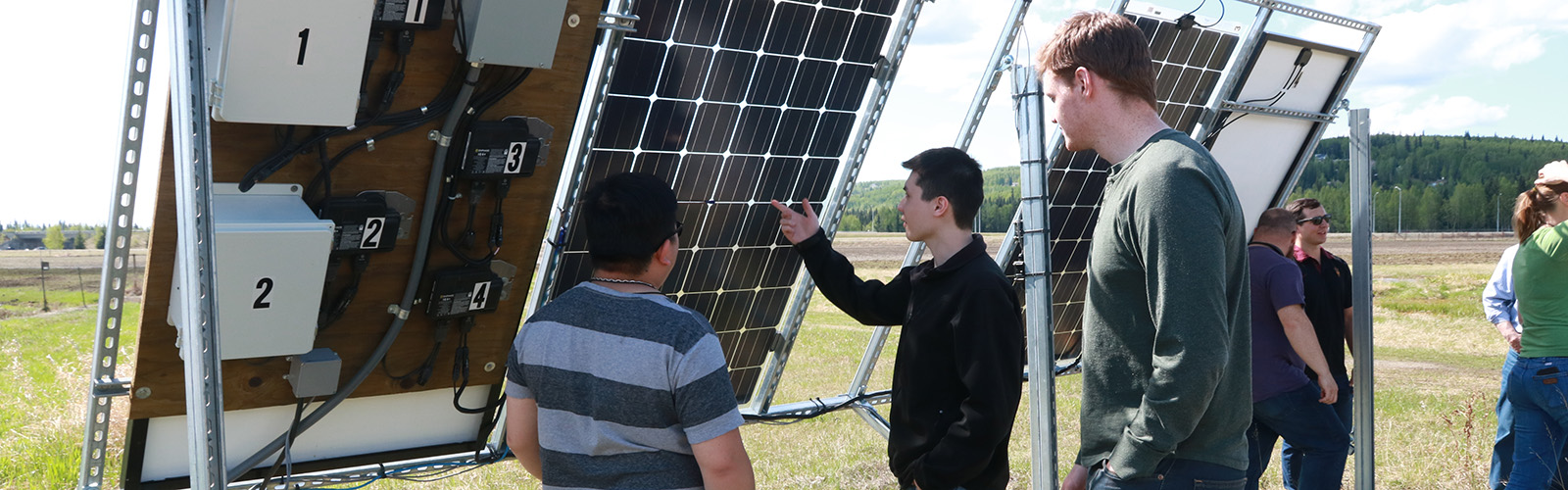
ACEP has partnered with the largest and only privately-owned solar farm in Alaska to test snow-shedding technologies developed by Michigan State University, University of Michigan and Sandia National Laboratories.
This project was carried out to increase the performance and resilience of photovoltaic (PV) systems used in cold regions of the U.S., thus aiding in the adoption, integration and optimal operation of the nation’s solar resources.
Having a unique access to electric utilities and private companies in Alaska, ACEP tries to find the benefit for all parties involved.
Solar Energy Research in Alaska
Since the first solar data collection in 2012, ACEP has witnessed dramatic decreases in the price of solar technology in Alaska, following global trends. Solar technology helps build sustainability and resilience in many isolated communities with the highest energy cost in the nation as well as remote locations around the world, including military.
In addition, testing solar PV installations in extreme conditions provides opportunities for trouble-shooting and refining options for other isolated locations.
MicroFEWs Project
This National Science Foundation project explores how renewable energy affects food, energy and water (FEW) security in rural communities in Alaska.
With specialists in civil engineer, modeling, social science and economic research on its team, the project works on many facets involving renewable energy and FEW security. These include understanding the many factors that influence FEW security (e.g., fuel), figuring out the best use of excess energy and how renewable energy can be used to create water, as well as understanding FEW security, what influences renewable energy and security, and how security might be improved in rural Alaska.
Solar Technologies Programs
In this video, Erin Whitney, program manager for the Data Collection and Analysis and the Solar Technologies programs, talks about her research that helps responsive solar photovoltaic (PV) technology development in high latitudes and cold regions around the world.
One such research project is to test snow-shedding additives to solar panels in high latitudes, with a goal to help communities enjoy solar panels even during the winter months.
Helping Remote Power Plants with an ACEP Tool
Henry Toal, an ACEP intern, talks about a device he and his team have developed called Onsite Real-time Collection Acquisition (ORCA).
ORCA collects data from power plants in remote Alaska and transmits back to ACEP.
This device has helped older plants with no capability of storing and accessing long-term data to access data and fix issues on-site, thus helping remote Alaska power plants to be more efficient.