Lenhart J.H. Grothe Resources Award Archives
The UAF Alumni Association, by unanimous vote at the Sept. 22-23, 2017 meeting of the Board of Directors, has decided to no longer oversee this award, as it believes it's more appropriate to have it considered at the unit level. We keep this page here for historical purposes, and to continue honoring the past recipients.
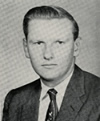
The Lenhart J.H. Grothe Resources Award was named after alumnus and tin miner Lenhart Grothe. Grothe, the award's first recipient, was a talented businessman who enjoyed sharing his wisdom with others. He started the Northern Exploration and Equipment Co. as a Fairbanks college student and graduated at the top of his class with a bachelor of science degree in mining engineering in 1957. Grothe, with his partner Tom Pearson, started Lost River Mining in Tin City and Nome, Alaska. Their mine in Tin City was the only operating tin mine in Alaska and the United States at the time. Grothe always said, "It doesn't matter what you do, just do what you do and do it well," and "Nothing is more valuable than your reputation as an honest person."
Criteria for selection: The Lenhart J.H. Grothe Resources Award is given posthumously to an alumnus who made significant contributions in the resource, mining or agricultural fields.
2016 Lenhart J.H. Grothe Resources Award winner
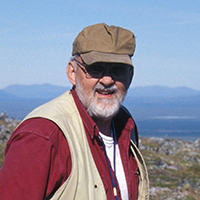
Donald John Grybeck `64
Studying and teaching about Alaska’s geology sustained Don Grybeck’s long and accomplished career. Don’s nickname was “Grizz,” which reflected his large stature and sometimes “blustery” personality, but he is remembered as a compassionate, humorous man with a great laugh.
Born in Indiana in 1936, Don dreamed as a child of going to Alaska. After serving in the Korean War, he enrolled at the University of Alaska in 1958. Summers, he worked as a surveyor for the Bureau of Land Management, a field geologist for the U.S. Geological Survey and a miner at Red Devil on the middle Kuskokwim River. Don graduated from UA with a bachelor’s degree in geological engineering in 1964. He continued to work summers for the USGS until earning a doctorate in 1969 at the Colorado School of Mines. While there, he married fellow student Ellen McGregor. She had a son, and they later had two daughters.
After graduate school, the family moved to Fairbanks, where Don taught at UA from 1970 to 1975. He then joined the U.S. Geological Survey in Anchorage and worked on mineral assessments in Southeast Alaska and the Brooks Range.
In 1979, Don became associate chief and then acting chief of the USGS Minerals Resources Program at the headquarters in Reston, Virginia. He was heavily involved in providing minerals information to Congress during debate over the 1980 Alaska National Interest Lands Conservation Act.
Don returned to Alaska in 1984 to lead the USGS Alaska geology branch during the height of the Alaska Mineral Resource Assessment Program. In the late 1990s, he and Alaska’s miners secured money to create the Alaska Resource Data File, the “go-to” source for minerals information in Alaska. He continued to work on ARDF after retiring and moving to Washington in 1999.
Don passed away in 2012 at his home in Port Ludlow, Washington.
2013 Lenhart J.H. Grothe Resources Award winner
Glen D. Franklin, ’36
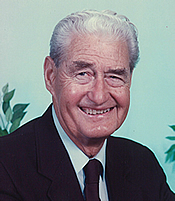
Glen Franklin was born on April 30, 1913, on a farm near Chewelah, Stevens County, Washington. In 1936 he graduated from the Alaska Agriculture and School of Mines, later the University of Alaska Fairbanks, with a bachelor’s degree in business administration, with a major in accounting and a minor in education. In April 1938 he married fellow alumna Vieno Wahto, who he met while in school.
Glen’s mining career started in the summer of 1936, when Ernest Patty hired him to be the chief operating accountant for Fairbanks-based Alluvial Golds and Gold Placers. In 1941, Glen registered for the draft and worked for Alaska Freight Lines doing strategic military work in Alaska for the War Department. After the war, Glen returned to the Alaska placer gold mining industry, and in 1945 with four partners — Charles F. Herbert, Leonard J. Stampe, Earl Ellingen and Harold Schmidt — he formed the Yukon Placer Mining Company.
Glen was a civic-minded individual. Having developed an interest in politics after the war, he ran unsuccessfully as an Independent for the Territorial House in 1947. In 1949 Glen ran and won as a conservative Democrat. He represented Alaska’s 4th Judicial Division in the Territorial Legislature and was part of the group that drafted the first Alaska statehood bill. When he wasn’t re-elected in 1953, Glen became a lobbyist for the Alaska Miners Association in Juneau until statehood.
After 1959, Glen Franklin and Harold "Smitty" Schmidt continued the Canadian placer mining operation; they operated together until 1965. Afterwards, Glen operated Franklin Enterprises, a subsidiary of the YPMC, on a small scale on Eldorado Creek until 1968.
When the price of gold began to rise in the mid-1970s, Glen worked as a placer consultant. During 1974-75, he worked with Toronto-based Livengood Joint Ventures, developing a largescale placer mining operation on the Livengood Bench north of Fairbanks. He also provided consulting expertise for operations in Idaho, Oregon and California, and internationally in Haiti, Mexico, and Italy.
Vieno died in 1980. In 1983, Glen pursued a relationship with Patricia Egan Sather, who had recently been widowed. That summer, Glen and Pat were married.
Glen was very active in the Pioneers of Alaska, and a strong supporter of the University of Alaska. Through the Pioneers Igloo #4, Glen directed the purchase and installation of the life-sized bronze statue of the first university president, Dr. Charles Bunnell, which still stands on the Fairbanks campus across from Signers’ Hall.
On the evening of June 17, 2008, Glen D. Franklin, aged 95, passed peacefully in his sleep with his wife, Pat, by his side.
It is with great honor that the UAF Alumni Association posthumously presents to Glen Franklin the 2013 Lenhart J.H. Grothe Resources Award.
2012 Lenhart J.H. Grothe Resources Award winner
Donald J. Cook, '47, '54
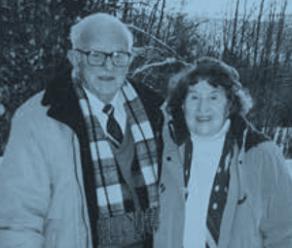
Donald Cook was a soldier, gold-miner, university professor, administrator, diplomat, author and Alaskan pioneer.
Cook was born on February 14, 1920, in Astoria, Oregon. At the age of 18, he arrived at the University of Alaska at Fairbanks where he enrolled in the mining engineering program and also became an ROTC cadet.
In 1943, he graduated from the first four-year UA ROTC program and was quickly shipped off to Fort Benning, Georgia, and later Fort Campbell, Kentucky, for advanced military training. As a lieutenant, his first combat assignment was at Utah Beach in Normandy, France where he arrived on D-Day plus one. His second assignment was to lead his unit in the notorious hedgerows near St. Lo, where he was wounded in action. He received the Purple Heart.
Cook spent 12 months in various military hospitals, but, later returned to Alaska and married Cora.
Cook received his bachelor’s degree in mineral engineering from the University of Alaska in Fairbanks in 1947 and spent 10 years as an engineer for the Fairbanks Exploration Co. in various mining operations throughout Interior Alaska.
The academic world called Cook again so he took his young family and moved to the
East Coast, where he enrolled in graduate school at Pennsylvania State University.
He earned both master’s and doctorate degrees in three years in the fields of mining
engineering and mineral preparation.
Upon graduation, the Cooks traveled back to Alaska where Donald began a lengthy career
as a college professor at UAF.
He helped train hundreds of young mining engineers. In 1983, Cook received the Distinguished Alumnus Award at UAF for his achievements. In 1985, he was hired as UAF’s dean of the School of Mining, Petroleum and Geological Engineering. He also became the director of the Mineral Industry Research Laboratory.
His commitment to academic excellence was rivaled only by his efforts to assist local miners in technology development and regulatory compliance for a safe environment.
Cook also loved to travel. He worked as a mine consultant in Columbia, South America. He took a sabbatical leave from UAF in the 1970s and traveled to Taiwan where he taught mineral engineering at Cheng Kung University. This visit opened a new door of international opportunity for UAF. Cook established a program for Chinese students to confer mining engineering degrees at the Fairbanks campus. His experiences in Taiwan and China led him to new friendships overseas. After retirement at UAF, Cook was appointed as an Alaska trade representative to Taiwan. He and Cora lived in Taipei for another year.
It is with great honor that the UAF Alumni Association posthumously presents to Donald Cook the 2012 Lenhart J.H. Grothe Resources Award.
2011 Lenhart J.H. Grothe Resources Award winner
Doug Colp, '40

Doug Colp graduated from the University of Alaska School of Mines (now UAF) in 1940 with a bachelor of science degree in mining engineering.
In his extraordinary 75-year mining career, Doug worked all over Alaska, primarily mining placer gold, but also consulting for companies doing coal mining, hard rock mining and mineral exploration. He worked the gold fields in the 1940s and 1950s at locations such as Gold Bench, Klery Creek, Myrtle Creek and Livengood, where he was able to take his family for the season. He was also a chief engineer and superintendent for Usibelli Coal Mine in the late 1950s.
Doug created the Mineral and Petroleum Technology associates degree program at UAF and taught there for 10 years from 1965-975. He directed mineral exploration crews, often working out of helicopters in the mid-1970s and later operated placer gold mines afterwards at locations such as Slate Creek, Candle, Tofty, Eagle Creek and Ketchum Creek. Doug was well respected for his expertise and well liked for his sense of humor and dependability. He enjoyed taking on challenging projects and responsibility.
Doug was a member of Pioneers of Alaska, Alaska Yukon Pioneers and Alaska Miners Association. At the age of 95, he was still defying odds by being actively involved in his placer gold mine in the Circle District.
2010 Lenhart J.H. Grothe Resources Award winner
Eskil Anderson '41
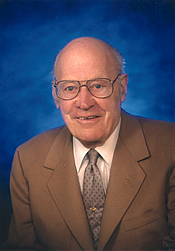
Eskil Anderson graduated from the University of Alaska at Fairbanks in 1941 with two bachelor of science degrees, in mining and geology and in geological engineering.
His work experience included underground mining for various companies, dredge engineer for the U. S. Smelting and Refining Company in Fairbanks, teacher of mining and geology courses at UAF, and exploration geologist for the Territorial Department of Mines in northern Alaska. In this position he walked as much as 150 miles at a time across mountains and tundra and traveled to offshore islands in Eskimo boats made of walrus skins.
In the mid-forties he became self-employed and with three partners acquired mining properties throughout Alaska. The best known was the gold properties held by the Little Squaw Gold Mining Company (now called The Goldrich Mining Company), where he was president from 1972 - 2002. He was a life member of The Northwest Mining Association where he served as president from 1966 - 1971, and he became the Alaska Mining Association’s fourth full time member in 1975. He has been a member of many professional mining organizations including 70 years of membership in the American Institute of Mining Engineers.
2009 Lenhart J.H. Grothe Resources Award winner
John Roland "Rollie" Snodgrass, '32

John Roland Snodgrass graduated from the Alaska Agricultural College and School of Mines, now known as the University of Alaska Fairbanks, with a bachelor of science degree in agriculture with honors in 1932.
Roland was a tireless proponent of Alaskan agriculture, both in public and private life; thus deserving, in the hearts of many, the true "Father of Agriculture" title in Alaska.
Former state senator Jay Kerttula wrote of Roland Snodgrass: "Rollie was exactly what was needed in the frontier—a Thomas Jefferson-archeologist-paleontologist, still revered on St. Lawrence Island. He worked with and exceeded the contribution of the immortals of Alaskan anthropology. A professor of genetics, chemistry, and agriculture; a surveyor and veterinarian; a lifetime Alaska farmer, land use planner, agricultural economist and director of the state Department of Agriculture."
During Roland’s term as director of agriculture, there were many projects he initiated, including some of the first land sales at Delta Junction, the meat inspection program, the grain incentive program, the frozen vegetable processing project in cooperation with the University and USDA, the reindeer slaughter plant at Nome, and the irrigation loans from AFLF due to the dry years in the late 1960s.
2008 Lenhart J.H. Grothe Resources Award winner
Ernest Wolff
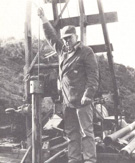
Ernest Wolff worked for the Territorial Department of Mines as an undergraduate and then as an observer and chief assistant at the College Observatory, operated by the Carnegie Institution of Washington. He became observer-in-charge of the College Geophysical Observatory of Alaska, later to become the Geophysical Institute. He was a consultant in mineral exploration in Interior and northern Alaska and a research assistant and associate professor at the University of Alaska School of Mines.
Ernie taught geology at the University of Oregon and Colorado State University. He was the assistant director of the Mineral Industry Research Laboratory in Fairbanks and professor of mining engineering at the School of Mines. He was a registered professional engineer and land surveyor and a member of many professional groups. He nurtured and formed the intellectual, political and principle core of many students. He is a legend of the School of Mines.
It is with great pleasure that the UAF Alumni Association awards posthumously to Ernest "Ernie" Wolff the Lenhart J.H. Grothe Resources award.